
PipeCloud was recently featured in a USA Today article examining shipyard throughput and productivity challenges in modern shipbuilding. The article includes insights from PipeCloud CEO and Co-Founder Jarno Soinila on the growing gap between digitally mature hull construction and slower, fragmented outfitting operations. You can read the full original article here.
The article, “The Outfitting Constraint: Unlocking Shipyard Throughput and Productivity in Shipbuilding” (published December 2, 2025), explores how shipyards have successfully optimized steel and hull production through automation and integrated planning, while outfitting work has struggled to keep pace. Soinila shares his perspective on why this imbalance has become a critical constraint on shipyard performance, particularly as vessel complexity continues to increase.
You can read the full original article here (US only).
Hull production advances while outfitting falls behind
According to Soinila, many shipyards have invested heavily in robotic welding, computer-controlled cutting systems, and tightly integrated planning tools for hull production. These investments have transformed early-stage construction into a more predictable and coordinated industrial process.
“In steel production, the digital transformation has already happened,” he says. “Automation and integrated workflows have pushed hull construction to a level of consistency and efficiency that shipbuilding outfitting simply hasn’t reached yet.”
As a result, outfitting operations often struggle to keep pace. Despite representing a large share of total construction effort on complex vessels, outfitting still relies heavily on manual installation methods, paper-based coordination, and disconnected systems.
“Outfitting teams often move between work orders, drawings, and spreadsheets that lack communication between each other,” Soinila explains. “This fragmentation creates delays, rework, and uncertainty at a scale that hull construction often no longer faces.”
Increasing vessel complexity amplifies the challenge
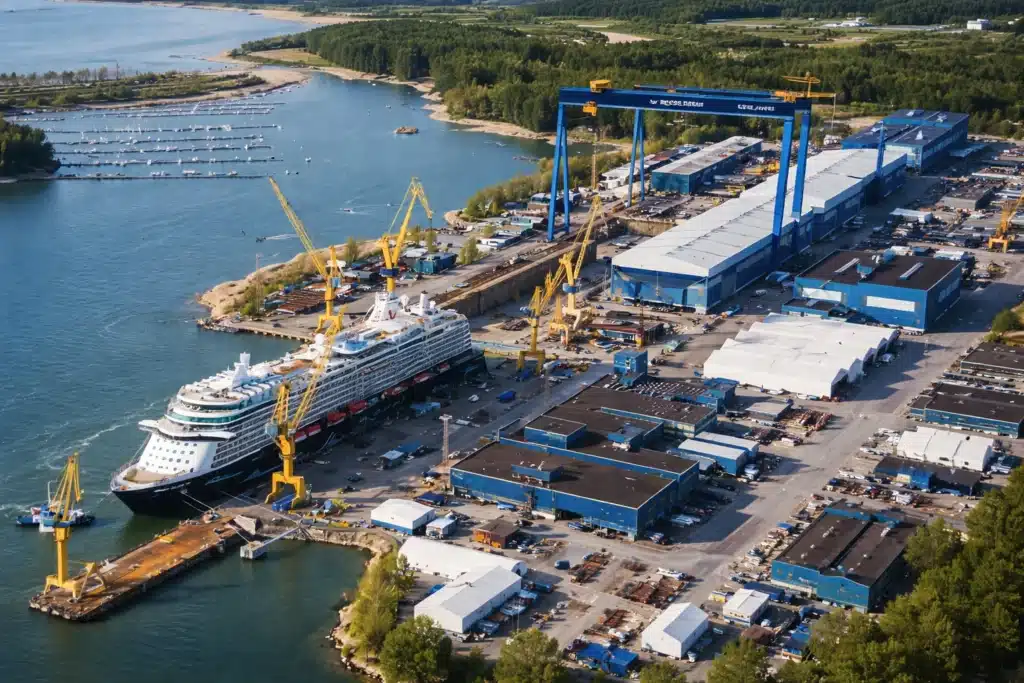
The article highlights how these challenges intensify as vessels become more sophisticated. On cruise ships, offshore assets, and naval vessels, dense piping networks, advanced equipment, and tightly coupled systems significantly increase outfitting workload and coordination demands.
“I believe that a 10% increase in vessel sophistication can lead to a 30% increase in outfitting workload,” Soinila says. “The trades can become more interdependent, the sequencing can become more delicate, and the room for error can become much smaller.”
With growing complexity, quality control also becomes harder to manage using manual tracking methods. According to Soinila, the lack of reliable digital traceability makes it difficult to identify issues early, when they are still relatively easy to correct.
“Every interface is a potential failure point,” Soinila emphasizes. “Without proper digital traceability, issues hide until late in the project, when they’re more expensive to fix.”
Block outfitting and the importance of timing
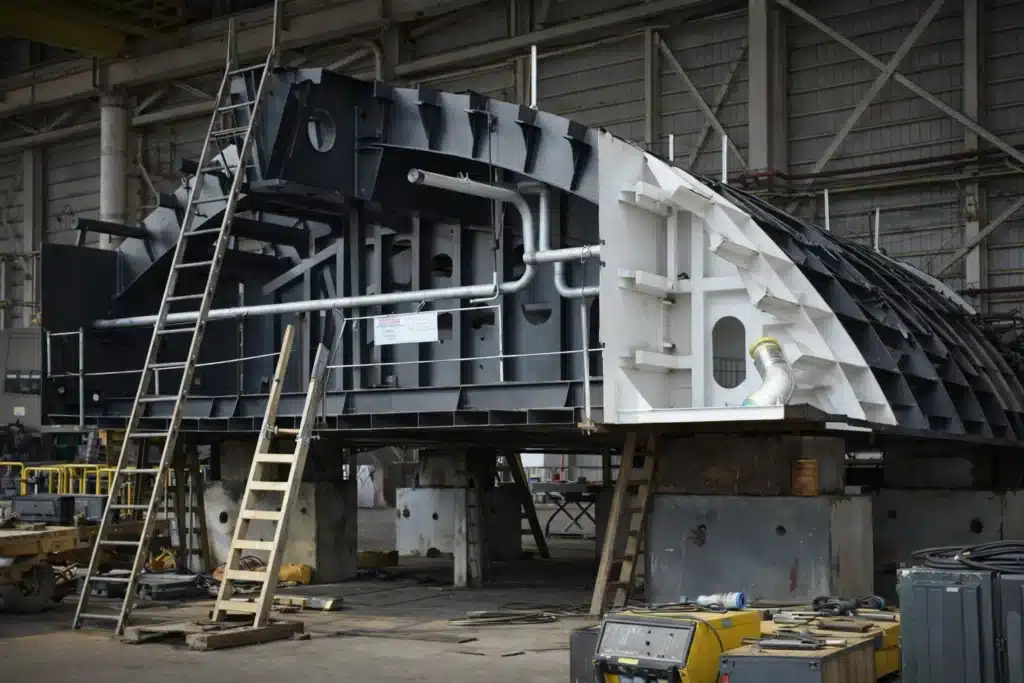
One of the key productivity levers discussed in the article is block outfitting, where technical systems are installed within steel blocks before final assembly. Soinila notes that shipyards with strong block outfitting practices consistently outperform those that install systems later in the process.
“Block outfitting is where the industry gains its biggest productivity advantage,” he explains. “But only if it’s done at the right time and in the right orientation.”
A particularly effective phase occurs early in block outfitting, when blocks are positioned upside down and accessibility is at its best.
“This is one of the most productive moments to install piping because ergonomics and accessibility are at their peak,” Soinila says. “The work goes faster, with fewer risks, and with much higher quality.”
However, the article points out that this advantage is often lost due to delays in pipe prefabrication. Late delivery of pipe isometrics and fabrication drawings can compress the prefabrication window and prevent shipyards from fully utilizing these high-productivity installation phases.
“Shipyards know the upside-down stage is the best moment,” Soinila says, “but if prefabrication isn’t ready, that window closes. And once it closes, productivity can drop dramatically.”
The role of digital prefabrication execution
According to Soinila, improving outfitting productivity requires prefabrication operations to reach a high level of speed, accuracy, and coordination. In the article, he outlines the need for automatic extraction of production data from CAD, reliable workshop workflows, integrated quality control, synchronized surface treatment, accurate delivery timing, and shared situational awareness across teams.
“Achieving this level of coordination most likely won’t occur with spreadsheets, paper lists, or generic manufacturing systems,” Soinila notes.
This is the operational gap PipeCloud is designed to address. In the article, Soinila describes PipeCloud as a real-time execution environment built specifically for pipe prefabrication and outfitting operations.
“PipeCloud connects design, prefabrication, quality control, logistics, and installation into one digital workflow,” he explains. “It gives every team, from engineering to shop-floor operators to onboard crews, the same live information at the moment they need it.”
Real-time dashboards, automated work sequences, capacity planning, and complete digital traceability form the backbone of the platform.
“When prefabrication flows digitally and predictably, everything else follows,” Soinila says. “Shipyards move faster, deliver better quality, and eliminate the bottlenecks that have held outfitting back for decades.”
Defining the next phase of shipbuilding competitiveness
The article concludes with the view that the next major productivity gains in shipbuilding will come from closing the digital gap between hull construction and outfitting.
“The future of shipbuilding competitiveness depends on outfitting productivity,” Soinila notes. “And the shipyards that embrace digital prefabrication and integrated execution will be the ones that lead it.”
Got questions?
We’re here to help.
Your questions matter. Drop us a line anytime. We’ll get back with the details you need.