
As published in the October 2026 issue of SNAME’s MT magazine: The Outfitting Constraint (PDF).
How reliable prefabrication can unlock shipyard throughput
A pipe spool that arrives three days late rarely delays only one installation task. It can block a sequence of welding, insulation, inspection, and downstream outfitting activities that were planned for an open block while access was still easy. Once that window closes, the same work moves into a confined, crowded, late-stage environment where labor hours multiply and schedule recovery becomes increasingly expensive.
This is why reliable pipe prefabrication is not simply a shop-floor improvement project. It is a shipyard throughput issue.
Walk through the steel processing bay of a competitive shipyard today and you will see a fundamentally different operation from 20 years ago. CNC plasma cutters, robotic welding, and integrated production planning software have compressed hull block cycle times and raised first-pass quality rates, often without proportional increases in headcount.
Step through the door into the outfitting trades and the contrast is jarring: hand-written travelers, material shortfalls discovered at the point of installation, and weld traceability packages assembled retroactively by supervisors racing classification deadlines.
The gap between hull and outfitting digital maturity is not simply an operational annoyance. It has become the primary constraint on shipyard throughput. It’s the single factor that most directly determines how quickly a vessel moves from keel-laying to delivery.
Understanding Block Outfitting
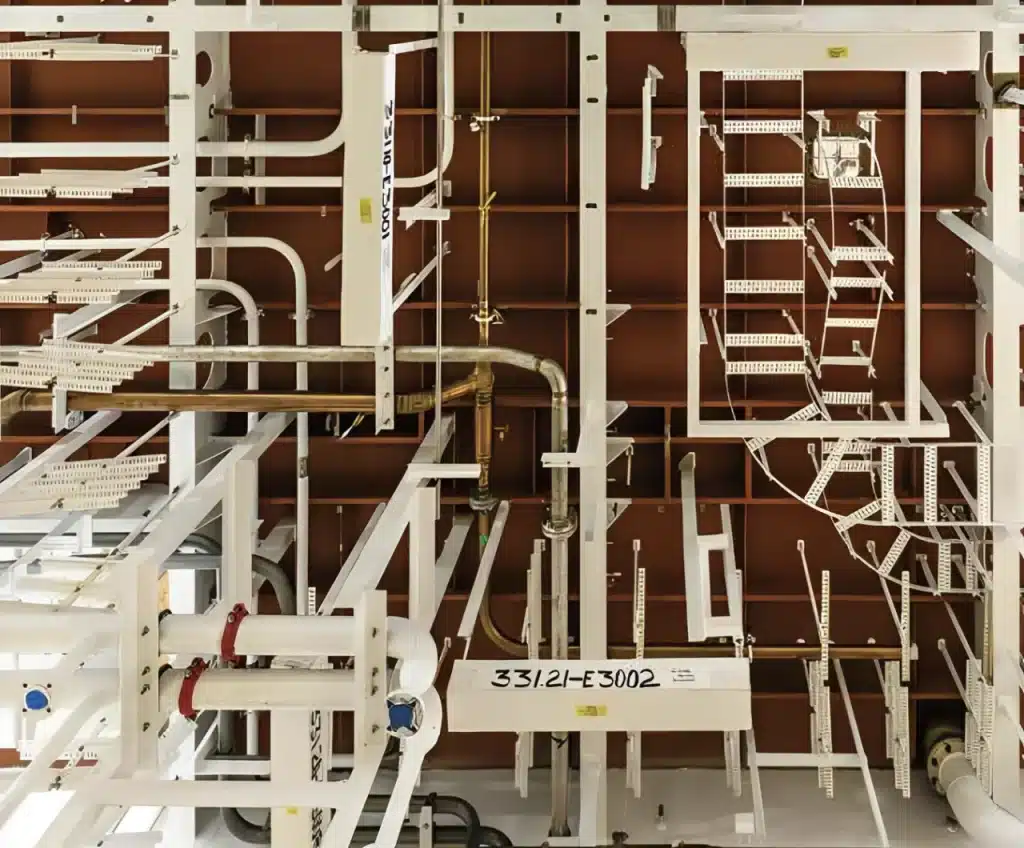
The concept of block outfitting is straightforward in principle and consequential in practice. Rather than installing piping, HVAC ducts, cable trays, foundations, and equipment after the vessel has been erected and the hull is closed, shipyards with mature outfitting workflows install as much of this content as possible while individual blocks are still in the assembly hall—open, accessible, well-lit, and at an ergonomically favorable working height.
The gains compound at every stage. At the block outfitting stage, a welder working in an open block can access joints that would require two hours of staging, scaffolding, and contortion inside a closed compartment. An insulation crew can line an entire pipe run in a fraction of the time it would take working through a restricted access hatch. A quality inspector can visually examine every weld in a piping circuit without removing lagging that was installed three weeks earlier.
Shipyards that have systematically pursued high block-outfitting ratios—meaning that a large proportion of outfitting work content is completed at the block stage rather than deferred to unit or erection—report labor productivity improvements of between 30% and 50% on comparable outfitting tasks. Research into late-stage outfitting rework has consistently found that when a pipe spool must be installed after the optimal block outfitting window has passed, the effective labor cost multiplies by a factor of three to nine, depending on compartment geometry, access constraints, and the extent of already-installed equipment that must be temporarily removed.
These numbers help explain why outfitting performance has such an outsized effect on overall project economics. On a complex naval or offshore vessel, outfitting can represent 60% to 70% of total labor hours. A 40% productivity swing across that workload dwarfs any efficiency improvement achievable in steel construction.
High Ratios
If the productivity argument for block outfitting is so compelling, why do so many shipyards struggle to sustain high ratios? The answer lies almost entirely in prefabrication reliability. Block outfitting is not a philosophical commitment; it is a logistical achievement. For a block to be outfitted before erection, the prefabricated pipe spools, supports, penetrations, and equipment foundations required for that block must arrive at the assembly position at the right time, in the right sequence, and to the right quality standard. If any of those conditions fail, the work is deferred.
In practice, prefabrication workshops routinely struggle to meet these conditions:
- spools are fabricated in the wrong sequence because the production order was generated without real-time visibility into hull construction progress
- material shortages are discovered mid-fabrication because the bill of materials was extracted from a design revision that has since been superseded
- weld repairs are performed without a clear record of the original defect, making non-destructive testing (NDT) closeout documentation impossible to assemble cleanly
- spools arrive at the assembly hall within the delivery window but fail dimensional checks because as-built measurements were never fed back to the design system.
Each of these failures individually appears manageable.
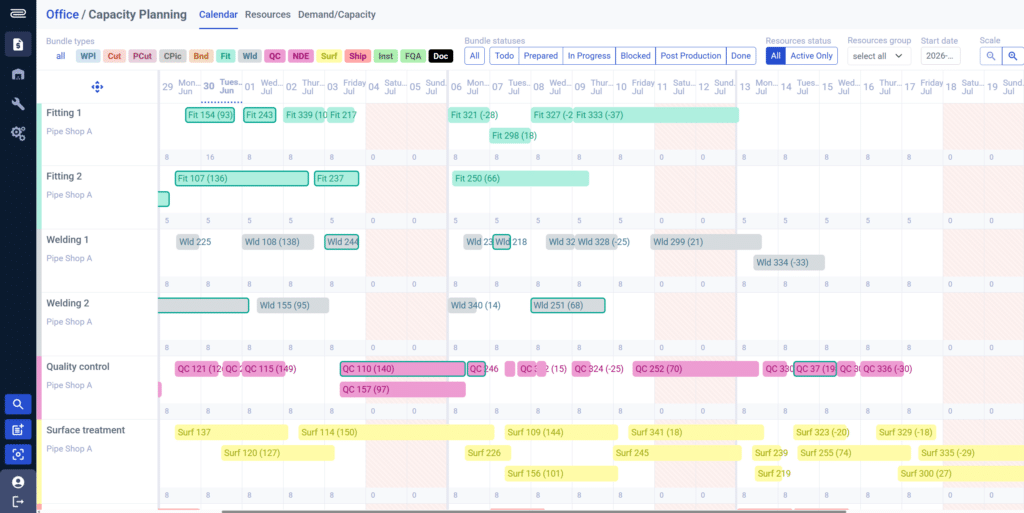
Collectively, they produce a prefabrication workflow that consistently delivers somewhere between 70% and 85% of required spools on time—a performance level that sounds reasonable until you understand that outfitting a block is a sequential process. If 15% of required spools are missing, it is rarely the last 15%. It is distributed throughout the system, meaning that installations that depend on the missing components cannot proceed, and the entire block may need to be deferred.
The root cause of chronic prefabrication unreliability is the same as the root cause of the wider outfitting constraint: a digital maturity gap. Most prefabrication workshops today operate with a disconnected set of tools—such as an ERP system that manages materials at a high level, a standalone welding management spreadsheet, a quality module that was never integrated with the production schedule, and a paper-based traveler system that provides no reaal-time status visibility to anyone outside the shop floor.
The consequences of this fragmentation are systematic and predictable. When the engineering team issues a revised isometric, there is no automated mechanism to flag which in-progress spools are affected and update their work packages. When a welder completes a joint, that completion is not immediately visible to the planner who is trying to decide whether to start the next phase of the same spool. When material is confirmed to be on order but not yet received, the production scheduler has no reliable way to know whether a planned fabrication start will be achievable.
These are not edge cases. They are the normal operating conditions of a prefabrication workshop that lacks digital integration. And they have a direct, measurable effect on the reliability of spool delivery and therefore on the shipyard’s ability to sustain high block-outfitting ratios.
Prefab In Practice
The characteristics of a digitally mature prefabrication workflow are well understood, even if their implementation remains the exception rather than the rule. The foundation is a single integrated data model that connects engineering design, material management, production planning, quality control, and delivery tracking in a unified system. When a designer releases a revised piping component file (PCF) or isometric drawing, the production system receives the update, flags affected work packages, and presents the planner with a clear view of what needs to change and what the downstream schedule implications are.
Production sequencing is driven by rules that incorporate the actual state of hull construction progress, material availability, and shop floor capacity, not by a static schedule generated at the start of the project and updated monthly. When a block assembly is accelerating ahead of plan, the prefabrication system can identify which spool packages need to be reprioritized and whether material exists to support the acceleration. When a block is slipping, it can identify fabrication capacity that could be redirected to a different block zone without disrupting overall delivery commitments.
Weld traceability is captured at the point of production rather than reconstructed retroactively. Each weld is recorded against the applicable welding procedure specification, the qualified welder’s certification, the consumable batch, and the preheat and post-weld heat treatment records where applicable. When the classification surveyor requests a weld traceability package, it is assembled in minutes from a complete digital record rather than in days from a combination of paper logs, memory, and educated guesswork.
Material availability is tracked at the spool-component level, not the purchase order level. The production planner can see not just that a bulk material order has been received, but exactly which spools that material can support, and which spools have outstanding shortfalls that need to be expedited or substituted. This granularity is the difference between a material management system that provides comfort and one that enables decisions.
Case Evidence
The operational case for digital prefabrication integration is not theoretical. Shipyards and fabrication contractors that have made the transition report consistent patterns of improvement across several dimensions.
At Helsinki Shipyard DNY Oy in Finland, the decision to integrate a digital pipe spool management system with the shipyard’s AVEVA E3D design environment was made in August 2025, with go-live achieved in June 2026. The integration established a direct data flow from design release to production planning through a custom PCF export script, eliminating the manual re-entry of spool data between the design and fabrication systems—a step that had previously been a consistent source of both delay and transcription error. Although the implementation is still in its early stages, first results are already visible: the time between design release and fabrication start has measurably shortened, and planners working from accurate, current data rather than stale extracts report improved first-pass quality rates on incoming spool packages.
Seaspan’s experience in British Columbia illustrates what becomes possible when digital production management is applied at scale under genuine program pressure. Victoria Shipyards fabricates pipe spools for vessels under construction at their facility, with the National Shipbuilding Strategy driving a sustained increase in program volume. The most demanding upcoming project is a new heavy polar icebreaker for the Canadian Coast Guard, the first to be built in Canada in 60 years. It requires more than 30,000 pipe spools, a volume that the existing paper-based production workflow could not support. In August 2024, the decision was made to comprehensively digitize the shop floor.
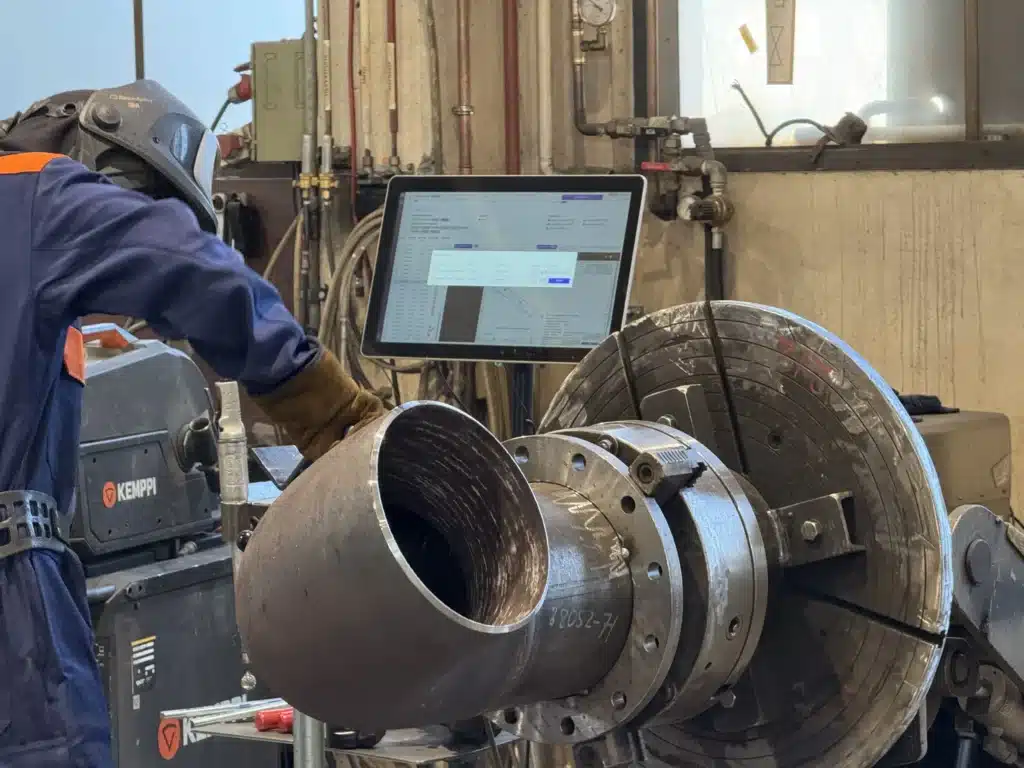
Go-live came in April 2025, at which time paper travelers were replaced by digital work packages, workstations were connected directly to a production management system, and real-time progress tracking gave planners immediate visibility across the full fabrication sequence. By the end of 2025, the results were measurable: annual throughput had grown from an average of approximately 4,500 spools per year toward a target of 9,500 to 10,000. This came not by adding proportional headcount or capital equipment, but by eliminating the coordination overhead and sequencing losses that the previous workflow had embedded into every production cycle.
Damen Naval’s pipe fabrication facility at Vlissingen-Oost in the Netherlands illustrates how significant the manual burden in manufacturing engineering can become before a structured digital solution is introduced. In September 2023, Damen Naval committed to replacing a workflow that had long relied on a combination of Excel spreadsheets for material and spool lists and a standalone legacy program for pipe-bending machine inputs. All of these were fed manually by the manufacturing engineering team whose role is to serve as the link between design and the shop floor. Go-live came in June 2024. The new workflow takes two file types from the engineering department as inputs: a PDF showing the finished pipe geometry and a PCF containing the full technical definition of coordinates, materials, joints, bends, and end preparations.
From these, the system automatically generates a complete delivery package for each spool—cutting lists, pipe bending data files formatted directly for the CNC bending machines, material lists, label print lists, and spool lists—in a process that now takes approximately 10 minutes for 50 pipes. Beyond the elimination of manual re-entry, the system also optimizes pipe nesting, calculating how many sections can be cut from each length of stock to minimize material waste and remove a further source of human error. With two years of operational experience behind it, the Vlissingen-Oost implementation has given the manufacturing engineering team substantially greater control over planning, progress monitoring, and traceability across the full pipe production cycle.
These examples share a structural similarity: the productivity gains are not primarily the result of people working harder or faster. They are the result of eliminating the non-productive time that fragmented workflows impose the time spent searching for information, correcting data entry errors, rebuilding documentation that should have been captured at the point of production, and managing the downstream consequences of decisions made on the basis of incomplete information.
Zone/Stage/System Model
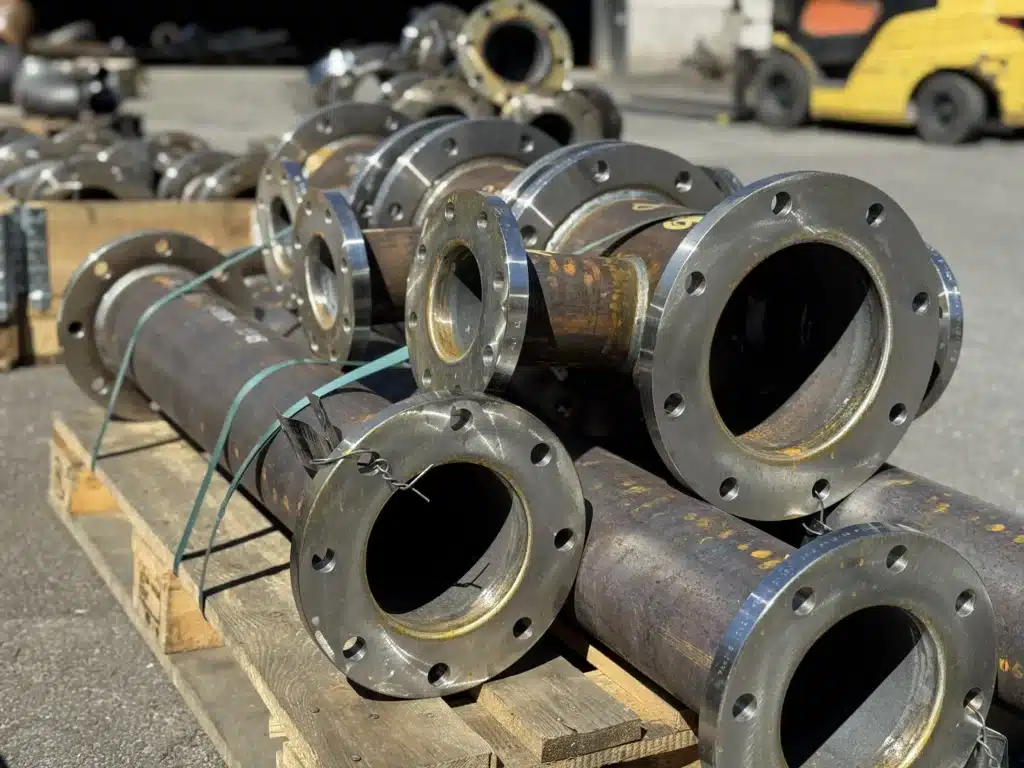
Shipyards operating at the highest level of outfitting performance typically organize their work using the zone/stage/system concurrent engineering model. In this framework, work packages are defined by the intersection of physical zone (a region of the vessel), construction stage (block, unit, erection, or commissioning), and system (piping, HVAC, electrical, equipment). This three-dimensional decomposition enables parallel execution: while one team is completing HVAC installation in a forward machinery space block, another is completing electrical cable pulling in the same zone at the unit stage, and a third is commissioning the diesel system in an aft compartment.
The model’s power depends entirely on the ability to deliver the right materials and fabricated components to the right stage at the right time. A zone/stage/system planning matrix is a scheduling commitment. For that commitment to be honored, the prefabrication workshop must deliver its output in a sequence that aligns with the production plan; this means the fabrication sequencing must be driven by the same production logic that governs the assembly schedule.
This is where digital continuity becomes decisive. In a shipyard where engineering, prefabrication, and assembly planning operate as separate data domains with periodic, manual synchronization, zone/stage/system planning quickly degrades into a theoretical framework. Blocks are outfitted with whatever is available rather than whatever the plan requires. Work packages that cannot be completed at the block stage are transferred to unit or erection without formal re-planning, eroding the efficiency gains the model was designed to capture.
Digital continuity—a single integrated data environment where engineering changes, production status, material availability, and quality records flow in real time across all functions—is the technical precondition for sustaining the zone/stage/system model under the conditions of a real shipbuilding program: evolving design, variable material lead times, and the daily reality of workforce and equipment constraints.
Toward Higher Ratios
For shipyards and fabrication contractors seeking to improve their outfitting performance, the evidence points toward a consistent set of priorities. The first is diagnostic honesty about where the actual constraint lies. In many operations, the belief that prefabrication delivery is the limiting factor is correct, but the cause of prefabrication unreliability is misdiagnosed as a workforce or capacity problem when it is actually an information problem. Understanding whether spools are being delivered late because of insufficient welding capacity, insufficient material availability, insufficient sequencing discipline, or insufficient visibility into what is actually needed and when is a prerequisite for directing improvement effort effectively.
The second is integration before automation. There is a persistent temptation to pursue visible technology investments (robotic welding, automated pipe bending, advanced measurement systems) before addressing the more fundamental problem of data fragmentation. A robotic welding cell that is loaded with the wrong sequence of spools because the production planning system lacks real-time visibility into block construction progress does not improve delivery reliability. It produces high-quality spools in the wrong order, faster.
The third is treating design-to-fabrication data flow as a first-order engineering problem, not an IT project. The latency between a design change and its reflection in active production work packages is one of the most consequential sources of rework and delay in prefabrication workshops. Reducing that latency—whether through direct computer-aided design integration, automated PCF processing, or structured application programming interface connections between engineering and execution systems—has a compounding benefit: it reduces rework, improves first-pass quality, and shortens the administrative cycle for quality documentation.
The fourth is recognizing that quality documentation is a production activity, not a closeout activity. Weld traceability, NDT records, dimensional inspection data, and material test certificates all need to exist in a complete, accessible digital form before the spool leaves the workshop. The cost of retroactive documentation assembly (in time, in error rate, and in the risk of classification non-conformances) consistently exceeds the cost of capturing the information at the point of production by a wide margin.
Eliminate The Constraint
The outfitting constraint is a structural feature of shipyards that have allowed the digital maturity gap between hull construction and outfitting workflows to persist. It is not inevitable. The technical and operational means to close that gap exist today, and a growing number of shipyards and fabrication contractors are demonstrating what is achievable when those means are applied with clarity about where the actual bottleneck lies.
The logic is linear. High block outfitting ratios are the mechanism by which outfitting work is shifted from sequential, constrained, late-stage installation into parallel, efficient, early-stage completion. High block-outfitting ratios require reliable prefabrication. Reliable prefabrication requires that the people making production decisions—planners, supervisors, material managers, quality engineers—are working from accurate, current information about design status, material availability, and production progress. That, in turn, requires the digital integration that most prefabrication workshops today still lack.
The productivity gains available on the other side of this transition are not incremental. On a complex vessel where outfitting represents the majority of labor hours, the difference between a prefabrication workflow that reliably supports high block-outfitting ratios and one that does not is measured in months of project duration and millions of dollars in labor cost. For shipyards operating in competitive markets with thin margins and demanding clients, that difference is existential.
The question is not whether digital prefabrication integration is worth pursuing. The evidence on that point is clear. The question is which shipyards will pursue it quickly enough to make it a competitive advantage rather than a baseline requirement. MT
By Jarno Soinila – CEO and co-founder of PipeCloud Oy, a Finnish software company specializing in pipe spool fabrication management and manufacturing execution systems.
Got questions?
We’re here to help.
Your questions matter. Drop us a line anytime. We’ll get back with the details you need.